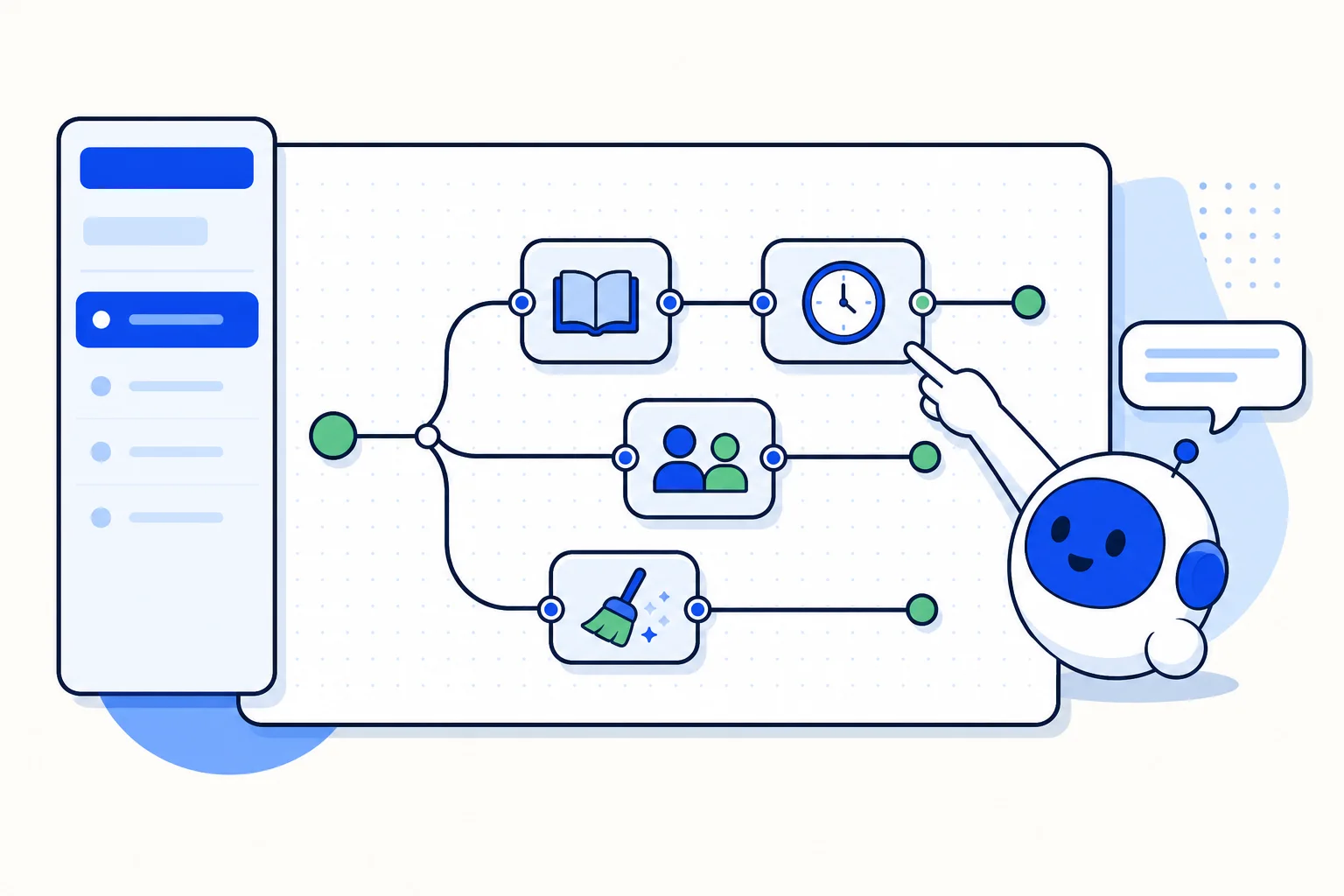
On October 5, HellouOne moved every production AI agent onto a new native runtime inside the platform. Until now, part of what an agent could do lived in external tooling that had to be configured separately and kept in sync with the inbox. That is over. Agents are now built, versioned and run inside HellouOne, with a visual editor to shape them and LIA, the admin assistant, able to edit them in conversation. This post covers what shipped, what changed for existing accounts, and why it matters for the businesses that depend on these agents every day.
What a native AI agent includes
The native runtime brings the pieces of an agent together in one place. Each agent now has:
A visual editor. The agent's behaviour is laid out as a flow you can see and edit, rather than settings spread across screens and a separate tool.
Versions. Every change creates a version, so you can see what the agent looked like before an edit and go back if a change does not work out.
Knowledge search. The agent searches the business's own knowledge to answer, so prices, policies and hours come from what you wrote, not from guesswork.
Flow tools. Steps for collecting information, branching on answers and taking actions, built into the editor.
Handover areas. Defined points where the agent hands the conversation to a person, with the context it gathered, so the handoff is a continuation rather than a restart.
Business hours. The agent knows when the team is available and behaves accordingly, for example by taking a message and setting expectations outside hours instead of promising a human who is not there.
An inactivity sweeper. Conversations the customer has gone quiet on are tidied up automatically, so the inbox reflects what is actually open.
Editable through LIA
All of the above can be edited through LIA. An admin can describe a change in plain language, in Spanish or English, and LIA proposes the edit to the agent, which the admin approves before it takes effect. That keeps the visual editor as the place to see the whole picture and LIA as the fast way to make a specific change, without the two getting out of step. Because every change is a version, an edit made through LIA is as reviewable and reversible as one made by hand.
What changed for existing accounts
All production agents were moved to the native runtime on October 5. For most accounts the migration was invisible from the customer's side: the agent kept answering on the same channels with the same knowledge. What admins will notice is that the agent now appears in the visual editor with a version history that starts at the migration, and that the handover areas, business hours and sweeper are now visible, configurable parts of the agent rather than behaviour that happened somewhere else.
Why this matters for businesses
Faster setup. A new agent goes from idea to live in one tool. There is no second system to create an account in, connect, and learn.
No external agent tooling. One fewer vendor, one fewer login, one fewer place where configuration can drift away from what the inbox expects.
Better handoffs between AI and humans. Handover areas are explicit. The team decides where the agent stops and a person starts, and the person receives the conversation with everything the agent learned, which is where most AI support experiences either succeed or fall apart.
Safer iteration. Versions mean an admin can tune an agent on a Tuesday afternoon without worrying about breaking Wednesday morning.
How to use it in HellouOne
Open your agent in the visual editor and walk through it once as a customer would: the greeting, the questions it asks, where it searches knowledge, where it hands over. Check that the handover areas match how your team actually works, set business hours to match the real schedule, and confirm the inactivity sweeper's behaviour suits your conversations. Then make your next change through LIA and review the version it creates. If you are starting from scratch, build the first version small: one job, one handover point, the knowledge it needs for that job. Expand once it is handling real conversations well. Everything described here is part of the HellouOne AI agent on the plans that include it.