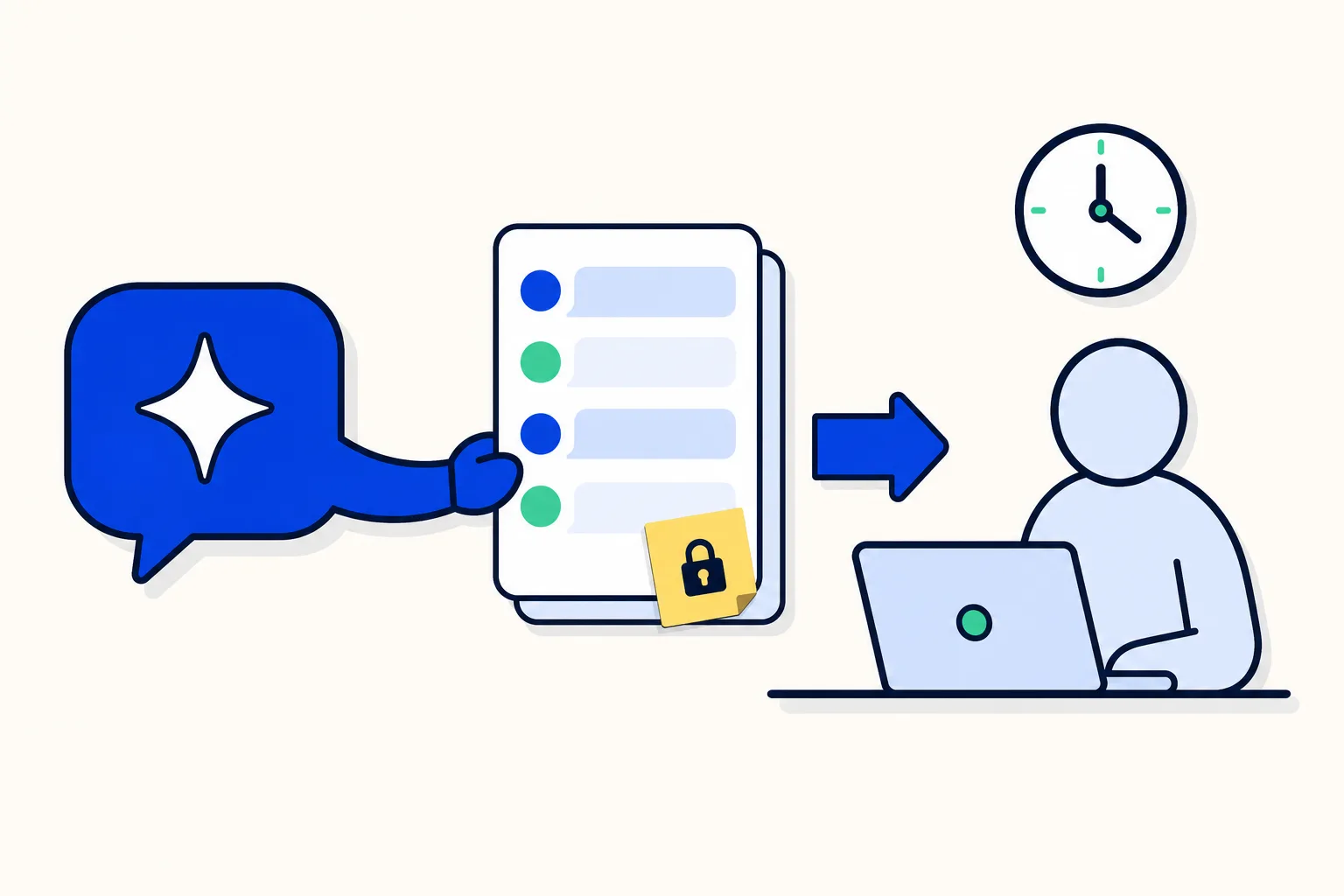
The question most owners ask before putting an AI agent on their WhatsApp number is not "how smart is it?" but "what happens when it gets something wrong?". It sometimes will, and the feature that decides whether that matters is the handoff: the moment the AI agent steps aside and a person takes the same chat.
A good handoff turns an AI agent from a risk into a filter. It takes the repetitive bulk of the day, and the conversations that need judgment, authority or empathy reach a person with the whole story already in the chat. This post covers the triggers that should always hand off, the ones that should not, how to write the rules in plain words, and how to tell whether they work. It expands the handoff section of our WhatsApp AI agent guide.
Why is handoff the feature that makes AI safe for a business?
Customers. Nobody minds an AI agent that answers "do you deliver to Medellín?" in two seconds. Everybody minds one that keeps looping when they are upset.
Your team. Without clear rules, people either distrust the AI agent and read every chat anyway, or trust it too much and miss the complaint that mattered.
WhatsApp itself. Meta's WhatsApp Business Messaging Policy says you may use automation when responding inside the 24-hour window, but must also have "prompt, clear, and direct escalation paths" available, and lists in-chat transfer to a human agent as one of them. An AI agent that can never reach a person is out of step with the platform it runs on.
Which conversations should always go to a person?
In each of these, a fluent answer from an AI agent is worse than a slower one from a person.
A complaint. "This arrived broken", "nobody called me back", "I'm cancelling". The customer wants someone accountable, not a well-worded apology.
A refund, discount or exception request. The AI agent should not have the authority to give money away, or to say no on the company's behalf.
A high-value lead ready to negotiate. Volume pricing, payment terms, a custom scope. The AI agent has qualified the lead; a salesperson closes.
A question outside the knowledge base. If the answer is not in the material you gave it, the AI agent should say so and bring in a person, not improvise.
The customer asks for a person. Any phrasing, any mood, no questions asked. Making someone ask twice is the fastest way to lose them.
Sensitive data. Card numbers, ID documents, medical details, a disputed charge. Hand off, and never let the AI agent collect them.
Repeated misunderstanding. If the same intent has been misread twice, a third attempt rarely goes better.
After-hours cases that need a promise. "Can you have it ready by 8 am?" needs someone who can commit. The AI agent collects the details and sets an expectation instead of agreeing.
Which conversations should the AI agent keep?
Every unnecessary handoff adds a wait for the customer and a chat for your team. These stay with the AI agent:
FAQ. Hours, address, parking, delivery zones, return policy.
Order status. With the AI agent connected to your store, "where is my order?" is a lookup, not a judgment call.
Booking and rescheduling. Checking a calendar and offering slots is exactly what it is for.
Product questions covered by your material. Sizes, compatibility, published prices.
Collecting information before a person is needed. Even when a case will end with a human, the AI agent can gather the order number or the photo of the damage first.
How do you write a handover rule in plain words?
A handover rule has three parts: a condition, a destination and, ideally, a note for the person taking over. You do not need a decision tree. Rules written the way you would brief a new hire are the ones that survive:
By topic: "If the customer mentions a refund, a chargeback or a cancellation, hand the conversation to Support."
By intent: "If the customer asks for a quote on more than 50 units, or about payment terms, hand to Sales and note the quantity."
By customer value: "If the contact is tagged VIP or has an open order above $500, hand to the account manager for anything that isn't order status."
By time of day: "Outside 8 am to 6 pm, collect the name, the order number and what they need, say a person will reply the next business morning, and hand to Support so it waits in the queue."
By signal: "If the customer writes 'lawyer', 'unacceptable' or in capitals, hand to Support immediately."
By explicit request: "If the customer asks for a person, a human or a manager, hand off at once and say who will pick it up."
Two habits help. Name a team as the destination, not a person, so holidays do not break the rule. And give each rule a one-line note for the receiver ("wants a refund on order 4471, already sent a photo"), so the handoff carries context.
What does a good handoff look like for the customer?
From the customer's side it is almost invisible.
Same chat. No new number, no "please email us", no form. The person answers in the thread the customer already has open.
No repeating. The first human message proves the chat was read: "Hi Laura, I see the order arrived damaged. I'm sorting it now."
A human name. "Carlos from Support will take it from here" lands better than "transferring you to an agent".
A realistic wait. "Within 15 minutes" only if that is true. "First thing tomorrow" beats a promise you break.
What does a good handoff look like for the team?
Full history, including what the AI agent said. The person needs the AI agent's answers, not just the customer's messages, to know what has already been promised.
An owner. Assignment rules give the conversation to one person in the destination team. Round-robin spreads the load; priority rules send the important ones to the senior person.
Private notes and @mentions. The receiver can leave a note the customer never sees, or pull a colleague in, without a side chat.
Visibility levels. A new hire sees their own conversations; a team lead sees the team's; the owner sees everything.
A reason. A label or note with the handoff motive ("refund request", "outside knowledge base") speeds up the first reply.
How do you measure whether handoff is working?
Start with the reports, not a target number, and tune the rules from what you see.
Handoff rate. The share of conversations the AI agent passed to a person. Climbing week over week usually means gaps in the knowledge base; near zero usually means a rule is too loose.
Time to first human reply after handoff. The handoff is instant; what the customer feels is how long the person takes. Watch it by team and by hour of day.
Conversations resolved by the AI agent versus by people. Cases that keep reaching people for the same reason are candidates for new material or a new rule.
What should happen after hours?
Most handoffs that go wrong happen at 9 pm: the chat goes to a team that is asleep, the customer reads "a person will take it from here", then silence until morning.
The fix is behaviour, not staffing. After hours the AI agent keeps doing everything in the "keep" list, and for anything that needs a person it collects what that person will need, tells the customer when to expect a reply, and queues the chat for the morning. If the customer never writes back, the conversation should not sit open forever: AI agents can auto-close silent conversations after up to 7 days, so the inbox shows only what still needs someone.
How this works in HellouOne
In HellouOne the rules above are called handover areas. You describe, in plain words, when the AI agent should step aside and which team takes over: "refunds and complaints go to Support", "quotes above 50 units go to Sales", "anyone asking for a person goes to the on-duty team". No code, no flowchart; the description is the rule.
When a handover fires, the conversation stays in the same WhatsApp thread and assignment rules give it an owner, round-robin or by priority, inside the destination team. The person sees the full history, including every message the AI agent sent, and can leave private notes and @mention a colleague without the customer seeing anything. Five visibility levels decide who can read what: own conversations, the team's, unassigned ones, everything in the inbox, or everything in the account. The sentiment report shows how conversations felt before and after a person stepped in, and the conversation, agent and team reports give you the handoff rate, response times and the AI-versus-people split described above.
The AI agent is included from the Starter plan, $49 a month with 2,000 AI messages; the 7-day trial needs no card. The human + AI solution page shows how the AI agent and your people share one number, and the customer service goal page walks through a support setup.
Write your first five rules today, read the reports in two weeks, and change one rule at a time. Handoff is the part of the AI agent you keep tuning.