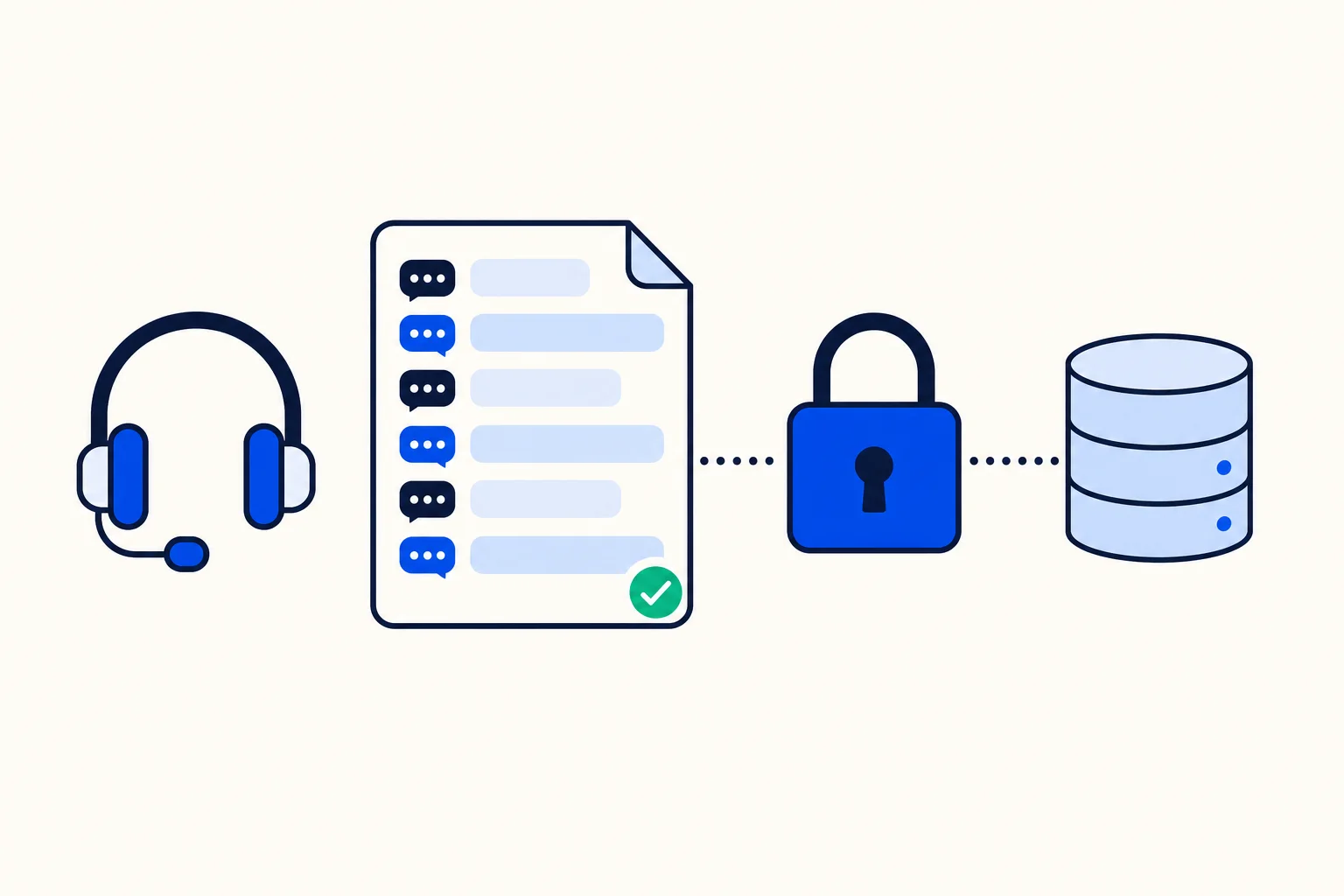
People say a lot on the phone. They give names, addresses, account details and the reason they are calling, and they often say more than they would type. A call transcript captures all of it, which makes the transcript one of the most valuable records an AI voice agent produces and one of the most sensitive. As of November 5, 2026, HellouOne protects it better: new call transcripts are stored encrypted at rest, and the full transcript no longer travels in the live updates sent to browsers. The change is live in production.
It is a privacy improvement for every customer that uses voice in HellouOne, including teams that run AI voice agents for inbound calls and outbound campaigns. You do not need to change anything to benefit from it.
What is new
Encrypted storage. New call transcripts are stored encrypted at rest. The encryption is applied by the HellouOne application, in its database.
Out of the live updates. The full transcript no longer travels in the stream of live updates that goes to browsers.
The same protection as the rest of the call record. Transcript segments and call summaries were already encrypted the same way. The full transcript now joins them.
Why it matters for voice customers
A transcript is more than a record. Supervisors search it to coach their team, quality teams review it, and the summary on the call card gives the next person context. All of that makes the transcript useful, and it also makes it something that deserves care. Storing it encrypted means the content of a conversation is not sitting in the database as plain text.
The second change is about movement. HellouOne screens update in real time, and the stream that keeps open browsers current used to be a place where a full transcript could travel. Now it does not. The full transcript stays out of that stream, so there is less of it in motion and fewer places where it appears.
What stays the same
Your team still reads transcripts the way it always did. Customers still read transcripts in the dashboard, on the call card and in the call history. They can also get them through the API: the endpoint GET calls/:id/transcript returns the transcript of a call. The API reference is in the HellouOne docs. Encryption at rest does not change how you read a transcript.
What this change covers, in plain terms
It helps to say exactly what the change is, so you can describe it correctly to your own team and customers.
It is encryption at rest, applied by the application, for new call transcripts. Transcripts of earlier calls are being migrated.
It is about how HellouOne stores and moves the transcript. It is not a statement about what happens after a transcript reaches your own systems through the API.
It does not describe end-to-end encryption, and this post does not claim a certification.
Being specific is part of the point. A privacy improvement is only useful if everyone describes it the same way, and a plain description is easier to review than a big promise.
A short checklist for teams that run voice
Review who on your team can open the call history and its transcripts, and keep that group as small as the work allows.
If you read transcripts through the API, check where your own systems store them, because the protection there is yours to manage.
Keep the complete transcript habit: review the whole call, including the part after a transfer to a person, as described in our post on one transcript for the whole call.
Tell your team what changed, in the plain terms above, so questions from customers get the same answer from everyone.
How this works with HellouOne
Every call handled by a HellouOne AI voice agent leaves a record: a transcript, an AI summary and a recording, as described on the AI voice agents page. With this change, the transcript part of that record is stored encrypted for new calls and stays out of the live-update stream, while your team keeps reading it where it always did: the dashboard and the API.
Phone, WhatsApp and AI calls share one place to be reviewed, the call history, as explained in one call history for phone, WhatsApp and AI calls. If you build on top of calls, the endpoint for transcripts and the rest of the API are documented in the HellouOne docs. Nothing about your calls, your voice agents or your reports changes, except that the words your customers said are better protected.